
Hair Loss in Women and Men: A Guide to the Four Types, Why They Happen, and When to Get Help
Contact Us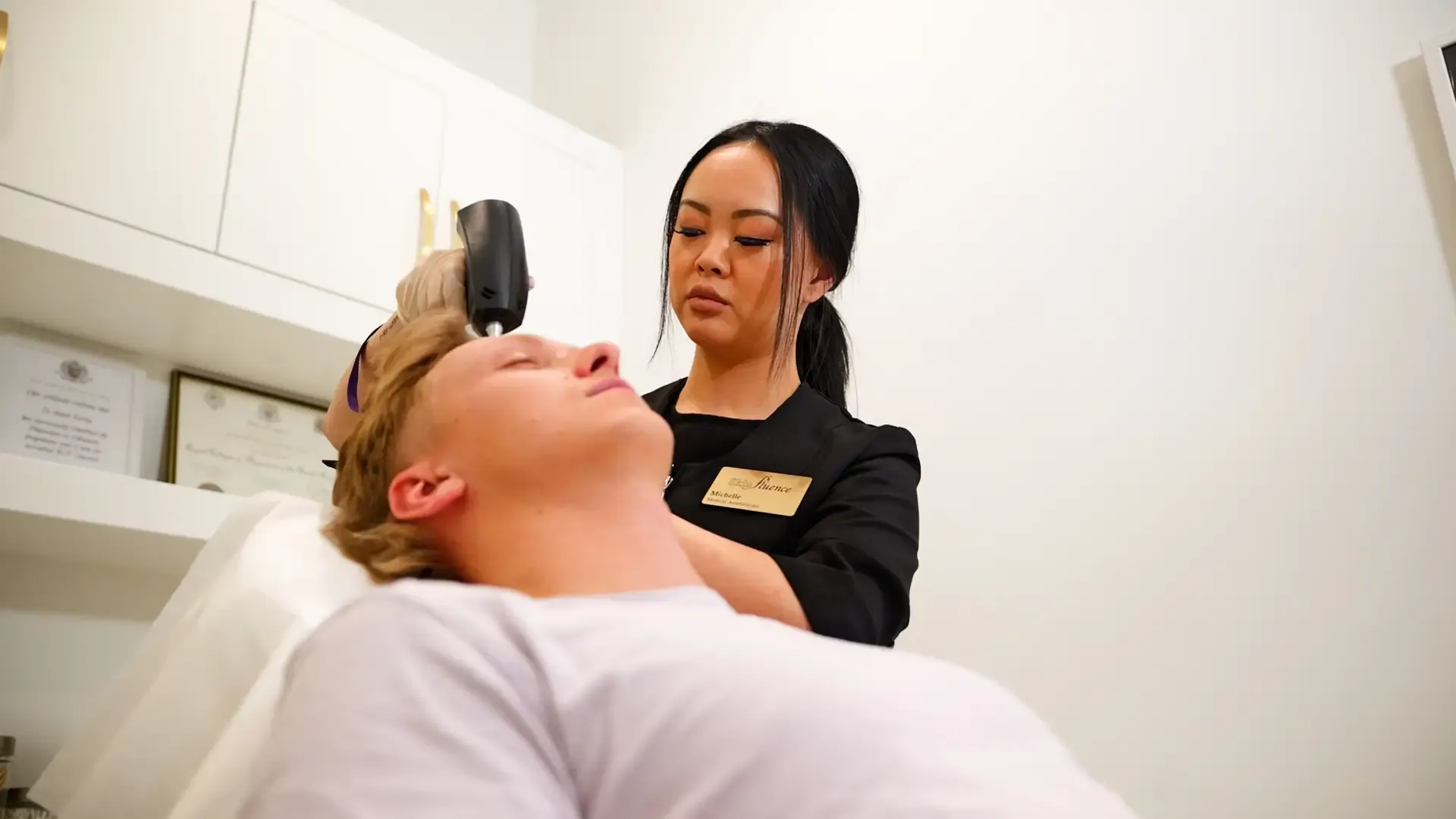
Table of Contents
- 1. First, the Hair Growth Cycle (Briefly, Because It Matters)
- 2. Type 1: Androgenetic Alopecia (Pattern Hair Loss)
- 3. Type 2: Telogen Effluvium (Shedding from a Trigger)
- 4. Type 3: Alopecia Areata (Autoimmune)
- 5. Type 4: Scarring (Cicatricial) Alopecias
- 6. How a Clinician Actually Tells Them Apart
- 7. The Treatment Landscape, Matched to Diagnosis
- 8. When You Should Stop Self-Managing and Get Evaluated
- 9. Hair Restoration at Skinfluence™ Calgary
Here’s something most people don’t realize about hair loss: it’s not one condition. It’s four. And the treatment that works for one type is often useless or in a couple of cases, actively the wrong call for another. Roughly half of all men and a significant portion of women will deal with androgenetic alopecia (pattern hair loss) at some point. Plenty more will run into one of the other three categories at least once. So before you spend money on a serum, a supplement stack, or a clinic treatment, the right question to ask isn’t what should I try. It’s what kind of hair loss is this.
This guide breaks down the four categories, how a clinician differentiates them, the workup involved, and the point at which professional evaluation should replace home experiments.
The article is educational. For an in-person scalp assessment in Calgary, the team at Skinfluence™ offers complimentary consultations.
First, the Hair Growth Cycle (Briefly, Because It Matters)
Every follicle on your scalp cycles independently through three phases. Anagen is the active growth phase and lasts 2–7 years; about 85–90% of your scalp follicles are in this phase right now. Catagen is a short transition phase of about two to three weeks where the follicle shrinks and detaches. Telogen is the resting phase two to four months long during which the hair shaft is retained until the next anagen cycle pushes it out. Losing 50 to 150 hairs a day is completely normal. Hair loss becomes clinically meaningful when one of three things changes: the ratio of resting to growing follicles shifts, the follicles miniaturize (start producing thinner, weaker shafts), or the follicles get destroyed by inflammation or scarring. Each of those mechanisms corresponds to a different category of hair loss.Type 1: Androgenetic Alopecia (Pattern Hair Loss)
This is the most common form in both sexes. It’s genetic. It’s androgen-mediated. The mechanism is straightforward: dihydrotestosterone (DHT) binds to androgen receptors in genetically susceptible follicles, shortens the active growth phase, and progressively miniaturizes the follicle until it only produces fine, non-pigmented vellus hair. The clinical presentation looks different in men and women, which is why two different classification scales exist: Male pattern hair loss affects the vertex and frontotemporal regions and gets classified using the Norwood-Hamilton scale (stages I–VII). The hairline recedes in the classic “M” pattern, the crown thins independently, and over time the two areas eventually merge. Female pattern hair loss preserves the frontal hairline (which is one of the most useful diagnostic tells) but produces diffuse thinning across the crown. It’s classified on the Ludwig scale (stages I–III, proposed by Erich Ludwig in 1977). The hallmark early sign is a widening central part. A smaller subset of women present with what’s called the Olsen “Christmas tree” pattern frontal accentuation visible when the hair is parted.How It’s Diagnosed
A few things, used in combination:- The hair pull test gentle traction applied to about 60 hairs. Losing more than six is abnormal.
- Trichoscopy, which is dermoscopy of the scalp. This identifies follicular miniaturization, hair shaft diameter variability, and yellow dots features that are specific to androgenetic alopecia and help differentiate it from telogen effluvium.
- Bloodwork for ferritin, TSH, vitamin D, complete blood count, and in women an androgen panel (DHEA-S, free testosterone, prolactin) to rule out an endocrine driver behind the pattern.
Type 2: Telogen Effluvium (Shedding from a Trigger)
This is the one most patients have actually experienced, even if they didn’t know what to call it. Telogen effluvium is a diffuse, non-scarring shedding triggered by a specific physiological stressor that pushes 20–30% of follicles prematurely into the resting phase. The shedding becomes visible about two to three months after the triggering event which is why patients often don’t connect the dots. The triggers fall into a fairly predictable list:- Acute illness, surgery, or a febrile event (post-COVID effluvium has been particularly common since 2021).
- Childbirth postpartum effluvium typically peaks 3–4 months after delivery.
- Significant or rapid weight loss, including weight loss driven by GLP-1 medications like semaglutide and tirzepatide. For a full breakdown, see our deep-dive: Does Ozempic Cause Hair Loss? A Complete Guide to GLP-1 Hair Shedding.
- Iron deficiency. Ferritin below 30 ng/mL is the textbook threshold; most hair-focused practitioners want it above 50.
- Thyroid dysfunction both hypo and hyper.
- Severe psychological stress.
- New medications, especially anticoagulants, beta-blockers, retinoids, and some antidepressants.
Type 3: Alopecia Areata (Autoimmune)
Alopecia areata looks nothing like the other categories. It’s a T-cell-mediated autoimmune condition where the immune system attacks active-phase follicles. The presentation is the giveaway: discrete, smooth, round patches of complete hair loss — not the diffuse thinning of androgenetic alopecia or telogen effluvium. It spans a spectrum:- Patchy alopecia areata one or several round, well-defined patches.
- Alopecia totalis complete loss of scalp hair.
- Alopecia universalis loss of all body hair.
Type 4: Scarring (Cicatricial) Alopecias
This category is the urgent one. Scarring alopecias permanently destroy the follicular unit through inflammation, leaving smooth, shiny, follicle-free patches of scalp. Common subtypes include frontal fibrosing alopecia (a recession of the frontal hairline often paired with eyebrow loss, predominantly in postmenopausal women), lichen planopilaris, and central centrifugal cicatricial alopecia (CCCA). The reason scarring alopecia is a medical urgency comes down to a hard biological fact: once a follicle is destroyed, no treatment regrows hair from that site. Early dermatologic evaluation and biopsy are essential to halt progression before more follicles are lost. If you’re seeing smooth, hairless patches with no visible pores, or you have persistent scalp pain, burning, or itching that won’t quit — get to a dermatologist this month, not next year.How a Clinician Actually Tells Them Apart
A proper assessment includes:- History. Onset (sudden versus gradual), pattern (diffuse versus patchy), family history, medications, recent illnesses, pregnancy, weight changes, diet, supplements, and any scalp symptoms.
- Scalp examination. Distribution of loss, presence or absence of follicular pores, scaling, redness, pustules.
- Trichoscopy. Magnified scalp imaging that identifies miniaturized hairs, exclamation point hairs, yellow dots, peripilar casts, and broken hairs. Each pattern points to a different diagnosis.
- Hair pull test and hair shaft examination.
- Bloodwork — ferritin, TSH, vitamin D, complete blood count, zinc, and an androgen panel when the history warrants.
- Scalp biopsy in cases of diagnostic uncertainty or suspected scarring alopecia.
The Treatment Landscape, Matched to Diagnosis
Different conditions, different tools:- Topical minoxidil (2%, 5%) is first-line for androgenetic alopecia in both sexes. It prolongs the active growth phase. It needs to be applied daily, basically forever.
- Oral finasteride (men) and low-dose oral minoxidil (both sexes) are prescription options for pattern hair loss.
- Nutritional correction. Iron, vitamin D, zinc, and protein adequacy address the modifiable contributors to shedding.
- Low-level laser therapy (LLLT) has FDA clearance and supportive evidence for androgenetic alopecia.
- Regenerative scalp treatments — platelet-rich plasma, exosomes, and ultrasound-based transepidermal delivery systems like Alma TED — are non-prescription options targeting scalp environment and follicular health. Evidence varies by modality, but they’re useful adjuncts.
- Dermatologic prescription therapy is required for alopecia areata, scarring alopecias, and any suspected endocrine driver.
When You Should Stop Self-Managing and Get Evaluated
Self-management is fine if your shedding is short-lived and has an obvious recent trigger. Get professional evaluation if any of the following is true:- Shedding has gone on for more than six months.
- There’s a visible change in your part width, hairline, or scalp visibility through the hair.
- The loss is patchy, sudden, or comes with scalp symptoms — pain, itch, burning, scaling.
- There’s a family history of pattern hair loss and you want to intervene early, before significant miniaturization sets in.
- Hair loss started after a new medication, a pregnancy, or a major weight change.